Association of Former Intelligence Officers

AFIO Eagle Logo

AFIO Central Office
6723 Whittier Avenue
Suite 200
McLean, Virginia 22101-4582
Telephone: 703 790 0320
Facsimile: 703 991 1278
Email: afio@afio.com
© 2008 AFIO
Copyright and Privacy Notice

Office of the Director of National Intelligence Offers 2nd Annual Summer Seminar for College Students Interested in I.C. Careers

National Security Analysis & Intelligence Summer Seminar (NSAISS)

July 11-23, 2010
Application deadline: March 7, 2010


The Office of the Director of National Intelligence's (ODNI) National Security Analysis & Intelligence Summer Seminar (NSAISS) is now accepting applications for a two week summer program in Washington, DC. NSAISS addresses critical national priorities in the U.S. Intelligence Community and offers participants the chance to study with currently serving intelligence analysts and other professionals through a curriculum of lectures, case studies, practice simulations, site visits to agencies, and other forms of exploration of intelligence disciplines, methodologies and substantive topics under the direction of the Intelligence Community, academia and private sector experts.

Selected participants will receive a one time, $500 stipend; accommodations, transportation to/from Washington D.C. and to all program activities; and temporary "Secret" level security clearance for the duration of the seminar.

THE APPLICATION DEADLINE IS MARCH 7, 2010.

The NSAISS is open to U.S. citizens who are graduate students, and to college seniors graduating in the 2009-2010 academic year and applying to graduate school. The seminar is not open to federal government employees, contractors or currently serving military or activated reservists. Participants will receive travel expenses, room and board, course materials and a $500 stipend.
The debut effort attracted more than 700 applicants for 40 slots.

The curriculum will be developed, in part, by the seminar’s sponsors – the deputy director of national intelligence for analysis, the IC’s chief human capital officer and the Community’s Centers of Academic Excellence Program.

For more information about the program, eligibility and application visit

http://www.orau.gov/nsaiss

Your Career in Intelligence

Is It Right For You
AND
Are You Right For It?


Deciding how to spend one’s life is not a trivial matter, but many of us tend to make that decision by default. “It seemed like a good idea at the time.” “My parents/best friends/teachers said I should/could do it.” “I wasn’t interested in anything (else).” Professional career counselors at universities try to guide students into occupations for which they appear best qualified, but their efforts can only suggest possibilities.

The foreign affairs field, of which intelligence is but one component, is one of these possibilities. It is an attractive field, because some agencies offer the opportunity of living and working overseas. This can have a great appeal to many Americans who have traveled abroad, whether because their parents worked overseas, or they went to a foreign country on vacation, or they spent a year of college on a year-abroad program.

Other reasons for seeking such a career include a patriotic desire to serve one’s country, the challenging and different work national security jobs offer, and a sense that overseas jobs will bring adventure. But how is one to know which of the many foreign affairs fields to aspire to, and then, how to prepare for this? How to know whether you want to work abroad most of your career or only occasionally?

Intelligence is the collection and analysis of information, particularly that which the originator wishes to protect or conceal. The United States Government (USG) not only collects information through the 16-member Intelligence Community (IC), which includes the State Department, elements of the Defense Department and the Central Intelligence Agency, but also through open sources, including major news organizations and internet sites. The National Security Agency and the National Geospatial Agency are devoted primarily to technical collection and analysis. The Federal Bureau of Investigation, the Defense Intelligence Agency and all of the military services have components charged with collecting and analyzing foreign intelligence, as do many other departments of the government. Even major business organizations with international operations collect and analyze information relating to products, competitors, and the risks and profitability of doing business in various overseas areas.

The CIA’s National Clandestine Service or NCS (formerly the Directorate of Operations) has the primary responsibility within the USG for the collection of human intelligence overseas, the stuff that novels and movies are made of. (Although Jack Ryan is described as an analyst in the Tom Clancy novels, his actions are an imaginative blend of various action officers and collectors.) The NCS, however, is only a fraction of the IC. The Directorate of Intelligence in CIA provides the analysis of “raw” information – information not yet subjected to critical analysis – collected by the NCS and other USG components in addition to mining the vast array of open sources. CIA’s Directorate of Science and Technology supports a variety of technical means for collecting intelligence. Its Directorate of Support provides and maintains the systems from which the others do their jobs. Thus the skill sets for candidates in each of these four components of the CIA are quite different.

The basic distinction between collector and analyst exists throughout the other members of the IC, although to varying degrees. In the Department of State, Foreign Service Officers assigned to embassies and consulates abroad openly collect information and send it back to Washington in cables that usually include their own analysis. Civil Service employees in State’s Bureau of Intelligence and Research analyze their colleagues’ cables along with intelligence from all other sources to provide a more complete analysis. Similarly, uniformed military officers assigned as defense attaches in embassies or as Foreign Area Officers overseas collect raw data that will be analyzed by their colleagues in the Defense Intelligence Agency (DIA).

There are no standard prerequisite courses for candidates to a career in the IC, but some attributes are obvious: an interest in international affairs; foreign travel and experience; the knowledge of one or more foreign languages, especially non-European languages; inter-personal skills; an analytical mind. In many cases, military experience is either required or highly desired. In others, such as the FBI, legal, forensic and cyber/IT training are valued.

A typical class of newly hired State Department or CIA officers will include individuals with business backgrounds, engineers, lawyers, scientists, accountants, IT specialists, artists – to name but a few of the range of backgrounds other than liberal arts majors. The IC today recognizes that the issues of the 21st century require a workforce with a broader range of skills, education and experience than in the past. Of course, every member of the IC has its own specialized training programs for candidates, but coming into these with some of these interests and experience can be helpful.

One excellent way to gain insight into the national security arena is through an internship in one of the government agencies. Many of them offer internships, be they summer-only programs, graduate school part-time programs, or even programs of a year or longer. Internships, and the opportunity for networking that they provide, can be an effective means to get your foot in the door, gain some experience, and see what working in the government is actually all about.

Analysts typically spend the majority of their careers in the United States, many in the Washington DC area. That said, most analysts will have the opportunity to travel overseas on tours of temporary duty, varying from a few days to a few years (for example: the analyst-in-Embassy program). Many can apply for advanced degrees sponsored by their agency in the IC. There are also many opportunities for analysts from one agency to rotate to another agency for a tour of one to two years.

Collectors of human intelligence typically spend the majority of their careers outside the United States, although it is rare for someone to spend more than two or three consecutive tours overseas without then coming back for an assignment in the US. A small minority of collectors will be under the cover of another organization, usually the State Department. There is also an effort to expand the use of non-traditional cover, that is, cover that does not involve another government agency. The Defense Department also has a number of collectors overseas, some in uniform, some not, focusing on the collection of intelligence relating to military requirements.

The first-time job seeker, or even the second-time seeker, may find the process of entering into a national security agency somewhat daunting, especially when faced with potentially more attractive offers and career possibilities in the private sector. For example, a job seeker is likely to encounter the following process:

Entering the work force:

1. Private industry can be more agile, not only in recruiting, but in business processes. Intelligence agencies are governed by many laws and regulations designed to keep them from intruding on the lives of private citizens. There is plenty of room for innovation in the national security arena, but activities are carefully regulated.

2. Those who choose national security work are generally going to spend a career in one agency (with an occasional detail to another agency being possible). Those who choose private industry, on the other hand, are likely, today, to have multiple employers over the course of a career.

3. Entry into a national security agency will entail a lengthy background investigation, possibly a polygraph and sometimes a brick wall results from prior use of illegal drugs. The various agencies have differing policies on prior drug use so it is impossible to explain here what would be acceptable. This investigation will delve into “life-style” issues (in addition to drug use, drinking, gambling, shoplifting, credit worthiness and unpaid debts, other illegal activities, etc.) as well as “counterintelligence” issues (family members or friends with foreign backgrounds or murky relationships).

4. Regardless of the barriers, however, an individual who wants a national security position needs to begin the application process well before the time that a pay check is necessary. The entire process, including security clearances (and the polygraph, if applicable) can take as much as a year, and sometimes longer. Both the Office of Personnel Management and the U.S. Congress are trying to expedite the job application process, but it remains a fact that entry into private industry is much more streamlined.

5. Going into national security work means that friends, teachers, neighbors, etc. are likely to be questioned during the background investigation about your suitability for positions of significant responsibility. This may also apply to jobs in private industry related to government support activities.

6. Acceptance into national security work, especially in a position that requires cover, severely restricts what you can say about that work. Many new employees underestimate the impact that work status has on themselves and, especially on their families. Questions regarding what you can tell your spouse, what spouses can say and with whom they can socialize may assume significant importance. For those going overseas, the question arises whether it is realistic to have a two-career family when you will be moved around the globe every two or three years.

Pay and incentives:

1. The federal government pays on a set scale. There are modest adjustments to pay within limits, but promotions are basically the only way to significantly increase your salary. Private industry has flexibility to pay what it feels necessary to maximize retention and profitability.

2. The federal government is typically more generous with annual leave, administrative leave, and medical leave than is private industry. You accrue additional hours of leave with each year of longevity in government service and you can carry over unused balances to a greater extent than is permitted in much of private industry.

3. Private industry often pays bonuses for superior performance or as part of profit-sharing incentives. Merit pay bonuses are available in government as well, but as with the pay scales, they are bounded. The federal government also recognizes superior performance with time-off awards, certificates of achievement, etc., much as the military recognizes superior achievement with medals.

4. Retirement accounts in private industry will be whatever has been negotiated, perhaps by a union, perhaps simply with senior employees. Each agency of the federal government offers its own retirement plan, based on longevity of service.

In addition, the federal government provides investment options in the Thrift Savings Plan, which is the government equivalent of the best 401 (K) plans available in the private sector.

5. The federal government offers attractive medical insurance plans which can be continued into retirement, a feature generally uncommon in industry.

6. As a general rule, the federal government offers more job security than private industry. Having made a serious investment in you during the long application process, the government is reluctant to dismiss you unless for good reason or a wholesale reduction-in-force. A private company, of course, can down-size for any reason or simply go out of business.

Status:

1. Once you are in federal service you will likely see that there are contract employees doing similar work in your work spaces but getting paid more than you. That could be an incentive to leave for higher pay. On the other hand, a career employee has job security with retirement and medical benefits – something the contract employee may not enjoy. Furthermore, people who enter a federal service career have the satisfaction of being representatives of their government in what they do.

2. Both tracks offer the opportunity to become a senior leader. Private industry can pay more; the federal government can provide an opportunity for you to help your agency “make a difference”.

The bottom line is that there are hurdles for the entry process, there are frustrations from having to do it “the way we always have,” and there are many thankless tasks. At least once in your career you may be part of a group accused of some conspiracy to get around the law and to hide the truth from the people. There are, however, rewards in the form of pride and accomplishment – both of which will proceed only from long-term commitment – even though you may not be able to talk about your accomplishments to many people. The world of intelligence does not often produce the excitement of a Bond movie, but it does offer the opportunity to play a part in securing the nation for now and for the future.

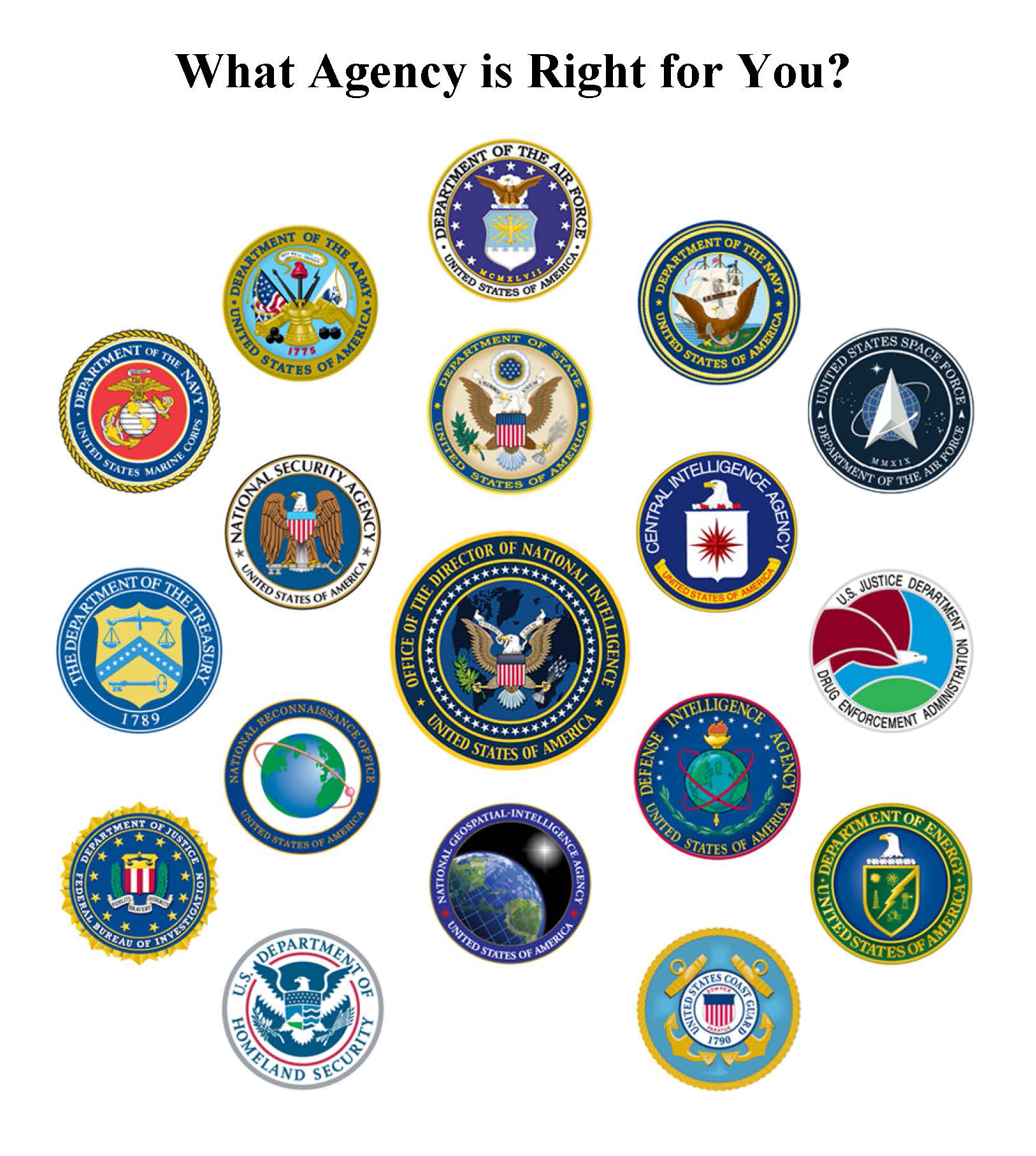
For the prospective candidate interested in intelligence as a career but uncertain where his or her abilities and interests might fit within one of the 16 members of the IC, the first step is to take a look at each of these members. A brief overview of the IC follows, along with a list of the members, a short description of each, and their principal web site addresses. Also attached is a listing of institutions offering courses in the subjects of intelligence and security.

Questions and Answers about Intelligence as a Career

Q.   How can I join the CIA, the FBI or another intelligence agency?
A.  Go to the website for the agency in question.  Most will have an application form on-line, which you can download and complete.   The website will also provide further information about what types of jobs are available in that agency.

Q.  What types of tests will I have to take before being accepted into an intelligence agency?
A.  Each agency will have its own battery of tests, but at a minimum an applicant can expect a math and verbal proficiency examination – similar to the SAT college boards.  Other tests might include a psychological examination, a language aptitude test, an oral examination before a panel, and/or a polygraph.

Q.  What training should I have before applying for an intelligence agency?
A.  There is no specific course of training for a career in intelligence.  Applicants who have foreign area experience, linguistic expertise (especially in “hard” languages such as Arabic, Dari, Pashto, Urdu, etc), military experience, managerial experience or expertise in information technology would be likely to have an edge over their peers.

Q. How old is too old to work for the Intelligence Community?
A.  There are no age limits, especially for analytical positions.  Because of lengthy training and rigorous physical requirements, field agents in the FBI and officers of the National Clandestine Service of the CIA are generally not accepted over the age of 35.

Q. Can I tell friends and family where I work?
A. For most agencies in the Intelligence Community, this is not an issue.  Employees of the  Department of Defense collection agencies, such as NSA, are discouraged from being specific about where they work.  Similarly, most officers in the National Collection Service of the CIA are urged to keep the number of people aware of this true employment to a minimum.

Q.  What are the most difficult aspects of working for an intelligence agency?
A.  For many in the Intelligence Community, especially, but not exclusively, those assigned overseas, the job can be 24/7.  You are always on-call, should a situation arise.  It can be difficult to separate your personal from your professional life – particularly in areas of conflict or crisis, man-made or natural. 

Q.  Are there specific rules or regulations for employees of the Intelligence Community?
A. Each agency has its own regulations regarding the personal conduct of its employees. The CIA, which is one of the most restrictive agencies, requires it employees to report all close and continuing contact with foreigners; employees must receive prior approval for foreign travel, unless they are assigned abroad; and they must receive prior approval for any written publication they author, even after they have retired or left the Agency’s service.

The Intelligence Community:

1. The Central Intelligence Agency (www.cia.gov)

2. The Defense Intelligence Agency (www.dia.gov)

3. The Department of Energy, Office of Intelligence and Counterintelligence (www.doe.gov/nationalsecurity)

4. The Department of Homeland Security, Office of Intelligence Analysis (www.dhs.gov)

5. The Department of State, Bureau of Intelligence and Research (www.state.gov/s/inr)

6. The Department of the Treasury, Office of Intelligence and Analysis (www.treasury.gov)

7. The Drug Enforcement Administration of the Department of Justice, Office of National Security Intelligence (www.usdoj.gov/dea)

8. The Federal Bureau of Investigation, National Security Branch (www.fbi.gov)

9. The National Geospatial Intelligence Agency of the Department of Defense (www.nga.mil)

10. The National Reconnaissance Office of the Department of Defense (www.nro.gov)

11. The National Security Agency of the Department of Defense (www.nsa.gov)

12. Air Force Intelligence, Surveillance, and Reconnaissance Agency of the Department of Defense (www.af.mil)

13. The U.S. Army Intelligence and Security Command of the Department of Defense (www.army.mil)

14. The Office of Naval Intelligence of the Department of Defense (www.nmic.navy.mil)

15. The Marine Corps Intelligence Agency of the Department of Defense (www.quantico.nmic.mil)

16. Coast Guard Intelligence of the Department of Homeland Security (www.uscg.mil)

The Director of National Intelligence serves as the head of the Intelligence Community, overseeing and directing the implementation of the National Intelligence Program and acting as the principal advisor to the President, the National Security Council, and the Homeland Security Council for intelligence matters. The mission of the Office of the Director of National Intelligence is to effectively integrate foreign, military and domestic intelligence in defense of the homeland and of United States interests abroad.
Congress provided the DNI with a number of authorities and duties, which charge the DNI to:

• Ensure that timely and objective national intelligence is provided to the President, the heads of departments and agencies of the executive branch; the Chairman of the Joint Chiefs of Staff and senior military commanders; and the Congress
• Establish objectives and priorities for collection, analysis, production, and dissemination of national intelligence
• Ensure maximum availability of and access to intelligence information within the Intelligence Community
• Develop and ensure the execution of an annual budget for the National Intelligence program (NIP) based on budget proposals provided by IC component organizations
• Oversee coordination of relationships with the intelligence or security services of foreign governments and international organizations (Under the E.O. 12333 rewrite, the DCIA and the FBI Director exercise DNI authority to require coordination of all intelligence activities taking place in their respective spheres of influence.)
• Ensure the most accurate analysis of intelligence is derived from all sources to support national security needs
• Develop personnel policies and programs to enhance the capacity for joint operations and to facilitate staffing of community management functions
• Oversee the development and implementation of a program management plan for acquisition of major systems, doing so jointly with the Secretary of Defense for DoD programs, that includes cost, schedule, and performance goals and program milestone criteria

1. The Central Intelligence Agency (CIA), established by the National Security Act of 1947, is responsible to the President through the Director of National Intelligence and accountable to the American people through the Intelligence Oversight Committees of the Congress. The Director of CIA also serves as the National Humint Manager. The CIA has two core missions:

    • To support the President, the National Security Council, and all officials who make and execute U.S. national security policy by providing accurate, comprehensive and timely foreign intelligence and analysis on national security topics.

    • To conduct counterintelligence activities, special activities and other functions related to foreign intelligence and national security as directed by the President.

The CIA is separated into four basic components: the National Clandestine Service, the Directorate of Intelligence, the Directorate of Science and Technology, and the Directorate of Support. These components carry out “the intelligence cycle,” the process of collecting, analyzing, and disseminating intelligence information to top U.S. government officials.

2. The Defense Intelligence Agency’s mission is to provide timely, objective, all-source military intelligence to policy-makers, to U.S. armed forces around the world, and to the U.S. acquisition community and force planners to counter a variety of threats and challenges across the spectrum of conflict. The Agency employs extensive expertise in such areas as foreign military forces; their intentions and capabilities; foreign military leadership; proliferation of weapons of mass destruction; defense-related political and economic developments; advanced military technologies and material production; information warfare; missile and space developments; defense-related medical and health issues.
The Director of DIA is a three-star military officer who serves as the principal advisor on substantive military intelligence matters to the Secretary of Defense and the Chairman of the Joint Chiefs of Staff. He is the Program Manager for the General Defense Intelligence Program, which funds a variety of military intelligence programs at and above corps level, and he is the Chairman of the Military Intelligence Board which examines key intelligence issues such as information technology architectures, program and budget issues, and defense intelligence inputs to National Intelligence Estimates.

3. The Department of Energy’s Office of Intelligence and Counterintelligence brings the access and expertise of the Department and its nationwide complex of laboratories and other facilities to bear on the challenges facing U.S. national security with regard to the worldwide threat of nuclear terrorism; the spread of nuclear technologies, materials and expertise; emerging foreign technology threats to U.S. economic and military interests; and the threat of foreign penetration of DOE facilities. In addition, the Office enriches the Intelligence Community with access to information on a variety of energy issues.
The DOE’s intelligence program originated during the Manhattan Project in World War II, when it was created to provide specialized analysis of the developing atomic weapons of the Soviet Union. Since then, intelligence at DOE has evolved in close concert with changing policy needs and the strengths of DOE’s unique scientific and technological base to address such matters as world energy crises, nuclear proliferation and nuclear terrorism.

4. The Office of Intelligence and Analysis of the Department of Homeland Security is responsible for using information and intelligence from multiple sources to identify and assess current and future threats to the United States, assess vulnerabilities, determine potential impacts, and disseminate timely information to state and local governments and the American public.
DHS intelligence analysts track terrorists and their networks and assess threats to U.S. critical infrastructures from bio-and nuclear terrorism. They assess the threats to U.S. air, land and sea borders, from pandemic diseases, and from radicalization within U.S. society. The Office is implementing a major plan to serve state and local governments by embedding intelligence officers in fusion centers nationwide.

5. The Bureau of Intelligence and Research of the Department of State provides the Secretary of State with timely, objective analysis of global developments. It serves as the focal point within the Department of State for all policy issues and activities involving the intelligence community. INR’s analysts draw on all-source intelligence, diplomatic reporting, public opinion polling and interaction with U.S. and foreign scholars to respond rapidly to changing policy priorities and to provide early warning and analysis of events and trends that affect U.S. foreign policy and national security interests. INR’s analysts – a combination of Foreign Service officers with extensive in-country experience and Civil Service specialists with in-depth expertise – cover all countries and regional or transnational issues.
In addition to all-source analysis and intelligence policy and coordination, INR analyzes and reports on geographical and international boundary issues; organizes some 300 conferences a year to facilitate the interchange of expertise and ideas between outside experts (foreign and domestic) and U.S. government officials; and administers the Title VIII Grant Program, funded by Congress for senior level academic research in Russian, Eurasian and East European studies.

6. The Office of Intelligence and Analysis within the Office of Terrorism and Financial Intelligence of the Department of the Treasury develops and implements U.S. government strategies to combat terrorist financing domestically and internationally, develops and implements the National Money Laundering Strategy as well as other policies and programs to fight financial crimes. It marshals the department's intelligence and enforcement functions with the twin aims of safeguarding the financial system against illicit use and combating rogue nations, terrorist facilitators, weapons of mass destruction proliferators, money launderers, drug kingpins, and other national security threats.

7. The Office of National Security Intelligence of The Drug Enforcement Administration is responsible for providing drug-related information responsive to Intelligence Community requirements. It was established to manage centralized tasking of requests for and analysis of national security information obtained during the course of DEA’s drug enforcement programs. The DEA helps optimize the overall U.S. Government counter-narcotics interdiction and security effort and furthers creative collaboration between the various federal, state, local, and foreign officials involved in countering the threats from narcotics trafficking, human trafficking, immigration crimes and global terrorism.

8. The National Security Branch of the Federal Bureau of Investigation was created in 2005 to position the FBI to protect the U.S. against weapons of mass destruction, terrorist attacks, foreign intelligence operations and espionage, and cyber-based attacks and high-technology crimes. The NSB consists of a Counterterrorism Division, a Counterintelligence Division, and a Directorate of Intelligence.
The FBI’s NSB integrates investigative and intelligence activities against current and emerging national security threats; provides timely information and analysis to the intelligence and law enforcement communities; and develops enabling capabilities, processes, and infrastructure, consistent with applicable laws, Attorney General and Director of National Intelligence guidance, and civil liberties.

9. The National Geospatial Agency provides timely, relevant, and accurate geospatial intelligence in support of national security objectives. It provides geospatial intelligence in all its forms, and from whatever source--imagery, imagery intelligence, and geospatial data and information--to ensure the knowledge foundation for planning, decision, and action. Geospatial intelligence is the exploitation and analysis of imagery and geospatial information to describe, assess, and visually depict physical features and geographically referenced activities on earth.
NGA provides support to civilian and military leaders and contributes to the state of readiness of U.S. military forces. The Agency also contributes to humanitarian relief efforts, such as peacekeeping operations, and tracking natural disasters.

10. The National Reconnaissance Office, established in 1961, designs, builds and operates the nation’s unique reconnaissance systems and conducts intelligence-related activities essential for U.S. national security. NRO products, provided to an expanding list of customers like the Central Intelligence Agency and the Department of Defense, can warn of potential trouble spots around the world, help plan military operations, and monitor the environment.

11. The National Security Agency/Central Security Service is America’s cryptologic organization. It coordinates, directs, and performs highly specialized activities to protect U.S. government information systems and produce foreign signals intelligence information. Its two primary missions are signals intelligence, or the exploitation of foreign signals for national foreign intelligence and counterintelligence purposes, and information assurance, or the protection of all classified and sensitive information stored or sent through U.S. government equipment. This includes the provision of technical solutions, products and services, and defensive information operations.

A high technology organization, NSA is on the frontiers of communications and data processing. It is also one of the most important centers of foreign language analysis and research within the government. Founded in 1952, NSA supports military customers, national policymakers, and the counterterrorism and counterintelligence communities, as well as key international allies.

12. The Air Force’s Intelligence, Surveillance, and Reconnaissance mission is to deliver sovereign options for the defense of the U.S. and its global interests. The Air Force integrates manned and unmanned aeronautical vehicles and space-based systems to provide continual situational awareness and information to the joint warfighter and national decision makers. ISR collection assets and analysis contribute to the overall goal of increasing the nation’s ability to gather and analyze intelligence on our adversaries.

The essence lies in the ability to apply selective force against specific targets because the nature and variety of future contingencies demand both precise and reliable use of military power with minimal risk and collateral damage. The ability of joint force commanders to keep pace with information and incorporate it into a campaign plan is crucial. Intelligence, surveillance and reconnaissance capabilities are at the core of determining desired warfighting effects.

13. The U.S. Army Intelligence and Security Command conducts intelligence, security and information operations for military commanders and national decision makers. Adapting to the changing paradigm of warfare, including counterterrorism and counter-insurgency operations, the Army is committed to provide all-source “actionable” intelligence along tactically useful timelines, to soldiers and commanders at all levels. It is increasing military intelligence capacity and skills balance. It is enabling distributed access to an all-source, flat, integrated network. It is expanding human intelligence capacities. And it is working to increase the ability of soldiers to understand their environment and recognize and report useful information.

14. The Navy’s Office of Naval Intelligence supports joint operational commanders with a worldwide organization and an integrated workforce of active duty, reserve, officer and enlisted and civilian professionals. ONI supports a variety of missions including U.S. military acquisition and development through scientific and technical analysis of naval weapons systems. The ONI also supports missions relating to counterterrorism, counter-proliferation, counter-narcotics and customs enforcement, and is working to structure interaction with other government organizations that can use or provide valuable intelligence related to seagoing issues. To that end, the Navy is helping create a new entity dedicated to maritime intelligence. Out of the Office of Naval Intelligence and the U.S. Coast Guard Intelligence Coordination Center in Suitland, Maryland, is coming a National Maritime Intelligence Center, or NMIC. The NMIC director will be responsible to the Director of National Intelligence as well as to the Director of Naval Intelligence. The NMIC will be on par with the National Counterterrorism Center and the National Counterproliferation Center, but it will focus on maritime domain issues.

15. The Marine Corps Intelligence Activity provides tailored intelligence and services to the Marine Corps, other branches of the military, and the Intelligence Community. These include threat assessments, estimates, and intelligence for service planning and decision-making. The MCIA also provides combat developers with threat data and other intelligence support for doctrine and force structure development, systems and equipment acquisition, war-gaming, and training and education.

16. The Coast Guard Intelligence became a statutory member of the Intelligence Community in December 2001. Its duties are to collect law enforcement intelligence on maritime threats, exchange information through relationships with government and private entities, conduct first order analysis, and disseminate tactical and operational intelligence directly to port level commanders as well as other Coast Guard units and government agencies. Because the Coast Guard employs unique expertise and capabilities in the maritime environment, both domestically and internationally, it has the ability to collect intelligence that supports not only Coast Guard, but other national security objectives as well.
The following is a partial list for the prospective student of the many colleges and universities that have begun to offer courses in the broad fields of intelligence and security. It is not meant to be all-inclusive.

The ODNI Centers of Academic Excellence

In 2005, the Office of the Director of National Intelligence (ODNI), on behalf of the U.S. Intelligence Community (IC), established the IC Centers of Academic Excellence (IC CAE) Program in National Security Studies. The emphasis is on building long-term partnerships with colleges and universities in core mission related academic disciplines in support of America’s National Security Mission during the 21st Century.
The goals of the CAE Program are threefold: (1) to develop long-term academic partnerships with accredited colleges and universities that have diverse student populations and courses of academic study that align with IC core skill requirements; (2) to provide financial and technical support to those educational institutions, so that they can shape curricula to meet specific IC needs; and (3) to leverage and cultivate IC relationships with students of those institutions to ensure that the IC has a diverse, highly-qualified, and motivated applicant pool for its mission-critical occupations.

All universities:

  1. - Develop or enhance curriculum to build the skill sets needed in the IC professions
  2. - Conduct pre-collegiate outreach in their geographic regions
  3. - Host a colloquium with consortium universities to heighten IC issues and careers
  4. - Send at least ten "IC Scholars" abroad to obtain language and cultural awareness or immersion experiences
  5. - Provide end of grading period reports for oversight and compliance of all program requirements
  • The 17 institutions in the CAE Program are:

 1. California State University, Los Angeles, California
 2. Clark Atlanta University, Atlanta, Georgia
 3. Florida Agricultural and Mechanical University, Tallahassee, FL
 4. Florida International University, Miami, Florida
 5. Miles College, Fairfield, AL
 6. Norfolk State University, Norfolk, Virginia
 7. Pennsylvania State University, University Park, PA
 8. Tennessee State University, Nashville, Tennessee
 9. Trinity University, Washington D.C.
10. University of Maryland, College Park, MD
11. University of Nebraska, Lincoln NE (in a consortium with the University of Nebraska, Omaha, Creighton University, Omaha and Bellevue University, Bellevue NE)
12. University of New Mexico, Albuquerque, NM
13. University of Texas at El Paso, Texas
14. University of Texas – Pan American, Edinburg, Texas
15. University of Washington, Seattle, Washington
16. Virginia Polytechnic Institute and State University, Blacksburg VA (in a consortium with Howard University, Washington DC)
17. Wayne State University, Detroit, Michigan

Application for employment varies among each of the 16 members of the Intelligence Community (IC). Although a position in the IC will always require a security clearance, there are considerable variations among the agencies regarding the nature of the clearance required (secret, top secret, top secret/code word, etc.) and the processes required to obtain that clearance (application forms, interviews, background investigation, polygraph).

The most stringent procedures are required by the CIA, NSA, NRO and NGA. In addition to lengthy application questionnaires and interviews, the applicant will have to undergo a complete background investigation, both for life-style and counterintelligence (CI) issues. The applicant will also have to successfully undergo a polygraph test. The time needed to complete this process, from the date the applicant receives a provisional offer of employment, may take many months.

The FBI requires a complete background investigation and a CI-scope polygraph for all new entrants. All positions today require a Top Secret security clearance – even cleaning and maintenance crews. The length of time for a background investigation varies by the time of year – there are typically more applicants in the summer and fall. During election cycles political appointees get priority over new-hires. Those applying for internships largely have to have a complete submission in by November for a summer position the following year. All applications for employment must be completed on the FBIJOBS web site.

The Bureau of Intelligence and Research at the State Department is composed of regular Foreign Service Officers who have passed the Foreign Service exam and may have served overseas and Civil Service Officers who do not have to complete the Foreign Service entrance exam, but who are required to have had full background investigations. Polygraph exams are not required for the State Department.

The Defense Intelligence Agency is composed primarily of Civil Service officers, who have had full background investigations, and some uniformed military officers. Many positions in DIA require a polygraph.

The intelligence components of the four armed services and the Coast Guard have uniformed military officers as well as civil service professionals. The intelligence components of these services and the Coast Guard who work in agencies such as NSA and CIA have to pass a polygraph examination.

The Departments of Energy, Treasury and Homeland Security all require full background investigations, as does the Drug Enforcement Administration. There is no polygraph. The Department of Homeland Security is actively recruiting individuals for its Office of Intelligence and Analysis. Potential applicants should look for specific vacancy announcements on the USAJOBS website (www.usajobs.gov).

The Office of the Director of National Intelligence (ODNI) has published has published a 97-page booklet, available on line (IC_Consumers_Guide2009), that describes the component parst of the Intelligence Community in some detail. The publication includes

o Intelligence Overview: defining and using intelligence; what is the Intelligence Community; what intelligence can and cannot do; sources of intelligence; levels of intelligence analysis; the intelligence cycle; and prioritizing intelligence issues.

o US intelligence organizations profiles: the ODNI; program managers (CIA, DIA, FBI, NGA, NSA); departmental components (Justice, Energy, Homeland Security, State, Treasury); service components (Army, Navy, Air Force, Marine Corps, Coast Guard); additional organizations (joint terrorism task forces, fusion centers).

o Oversight (executive, legislative, financial).

Training Ideas:

Intelligence Community Jobs and Language Learning Opportunities: In classes here in the U.S. or abroad, or on your own. Some sources -

Middlebury-Monterey Language Academy- offers top-quality summer language immersion—for middle and high school students - Arabic, Chinese, Portuguese, Spanish, French, Russian, Italian, Japanese and German.

Monterey Institute of International Studies - special total immersion summer and winter classes in Arabic, Mandarin Chinese, French, Russian, and Spanish.

The Language Conservatory holds a June-July Summer Language Camp (Camps available: Preschool through Grade 12). Swimming, tennis and volleyball will be offered between foreign language lessons offering total language immersion. This will be a unique Summer Language Camp Program in a country club setting in the North Dallas area. Each Camp runs one week, Monday through Friday between 9am and 2pm. The cost per week is $275.00 which includes learning materials snacks and lunch.

Lingua Service Worldwide, 800-394-5327, is based in Connecticut and represents more than 60 language schools around the globe. The company regularly visits schools to monitor performance, and provides applicants with contact info for former students.

LanguageCourse.net 800-613-6345, based in Barcelona, lists more than 400 schools worldwide. Schools are given star ratings by former students, and there's an online forum with uncensored reviews. The schools must be accredited and must have been in business for at least three year.

Atlanta International Language Institute - based in Atlanta, GA, teaches in group or private classes over 60 languages, including Afrikaans, Amharic, Arabic, Armenian, Bambara, Bamanankan, Belarussian, Bengali, Berber, Bosnian, Breton, Bulgarian, Cantonese, Chinese (Mandarin), Czech, Danish, Dutch, Estonian, Farsi, Finnish, French, Fujian, Georgian, German, Greek (Modern), Hebrew, Hindi, Hungarian, Italian, Japanese, Kazakh, Korean, Kyrgyz, Lao, Latvian, Lingala, Lithuanian, Malaysian, Malay, Mandi, Mongolian, Norwegian, Polish, Portuguese, Punjabi, Romanian, Russian, Serbo-Croatian, Slovak, Spanish, Swahili, Swedish, Taiwanese, Thai, Turkish, Ukrainian, Urdu, Uzbek, Vietnamese, Wolof and Yoruba.

Intelligence Community Jobs for Students -

Central Intelligence Agency – https://www.cia.gov/careers/student-opportunities/index.html

Defense Intelligence Agency – http://www.dia.mil/employment/index.htm

Federal Bureau of Investigation – http://www.fbijobs.gov/2.asp

National Geospatial-Intelligence Agency – http://nga.mil/careers

National Security Agency – http://www.nsa.gov/careers/students.cfm

Office of Naval Intelligence – http://www.nmic.navy.mil/employment

NOTE: Deadlines for summer internships in the Intelligence Community are in the fall (October and November) for the following summer.

OPPORTUNITIES FOR CURRENT STUDENTS
The members of the Intelligence Community (IC) offer high school and college students a variety of temporary employment opportunities, including paid internships and co-operative education programs. Such programs allow interested students to experience first-hand what it is like to work in the IC and if it is a “fit” for them. At the same time, the IC agency is able to evaluate the students’ work performance and consider them for permanent employment upon graduation.
In addition, many IC agencies offer scholarships or fellowships, some of which provide a salary and full government benefits as well as tuition and other educational expenses. Interested students should consult the Student/Special Programs web page at the various agencies to learn exactly what programs each offers.

  1. TEMPORARY EMPLOYMENT OPPORTUNITIES
    You can contribute to the work of the nation before you graduate as most of the IC components offer summer internship programs and some offer internships during the academic year. Some of the IC components also offer co-operative education programs which are formal programs linking a student’s major with relevant work experience. Most of the co-op programs are for college level students, however the National Security Agency does have a high school co-op program. Interns and co-op students engage in substantive and meaningful work assignments, while earning a competitive hourly wage and gaining valuable practical experience. Competitive is particularly keen for these programs with application deadlines six to nine months in advance of the period in which you wish to work. Applicants are expected to meet the same employment standards as permanent employees. Applicants must be U.S. citizens and should have a strong academic record (GPA of 3.0 or better). Foreign language skills, previous study or residency abroad and military service are pluses. Outstanding interpersonal and communication skills are essential. Some agencies require medical examinations and/or polygraph examinations as well as a background investigation. Some agencies also offer unpaid internships.
    In addition to the above, the following institutions have offered or currently offer courses in intelligence and security subjects. (Because curricula vary and change from year to year, the list is not definitive.)
  1. American Military University (on-line)
    American University, Washington DC
    Arizona State University, Tempe, Arizona
    Auburn University, Homeland Security Institute, Auburn, Georgia
    Bergen Community College, Paramus, New Jersey
    Bradley University, Peoria, Illinois
    Boise State University, Boise, Idaho
    Boston University, Boston, Massachusetts
    California State University, San Bernadino, California
    Campbell University, Buies Creek, North Carolina
    Case Western Reserve University, Cleveland, Ohio
    Catholic University, Washington DC
    The Center for Counterintelligence and Security Studies, Alexandria, VA
    Central Pennsylvania College, Summerdale, Pennsylvania
    Central Missouri State University, Warrensburg, Missouri
    Columbia University, New York, New York
    Dartmouth College, Hanover New Hampshire
    DeSales University, Center Valley, Pennsylvania
  2. Drew University, Madison, New Jersey
    Embry-Riddle Aeronautical University, Anchorage, Alaska
    Fairmont State University, Fairmont, West Virginia
    Franklin and Marshall College, Lancaster, Pennsylvania
    George Mason University, Fairfax, Virginia
    Georgetown University, Washington DC
    George Washington University, Elliot School of International Affairs, Washington DC
    Henley-Putnam University (on-line)
    Hunter College, New York, New York
    The Institute of World Politics, Washington DC
    Long Island University, Riverhead, New York
    Massachusetts Institute of Technology, Cambridge, Massachusetts
    Mercyhurst College, Institute for Intelligence Studies, Erie, Pennsylvania
    National Defense Intelligence College, Washington DC
    New Jersey City University, College of Professional Studies, Jersey City, New Jersey
    New York University, New York, New York
    North Carolina Wesleyan College, Rocky Mount, North Carolina
    North Georgia College and State University, Dahlonega, Georgia
    Norwich University, Northfield, Vermont
    Notre Dame College, Center for Professional Development, Cleveland, Ohio
    Ohio State University, Columbus, Ohio
    Ohio University, Athens, Ohio
    Point Park University, Pittsburgh, Pennsylvania
    Rockhurst University, Global Studies Center, Kansas City Missouri
    Rutgers University, New Brunswick, New Jersey
  3. Saint Leo University, Saint Leo, Florida
    State University of New York, Rockefeller College of Public Affairs and Policy, Albany, New York
    Syracuse University, Institute for National Security and Counterterrorism, Syracuse, New York
    Temple University, Philadelphia, Pennsylvania
    University of Detroit, Detroit, Michigan
    University of Kentucky, Patterson School of Diplomacy and International Commerce, Lexington, Kentucky
    University of Maine, Orono, Maine
    University of Miami, Coral Gables, Florida
    University of Michigan, Ann Arbor, Michigan
  4. University of Minnesota, Hubert Humphrey School of Public Affairs, Minneapolis, Minnesota
    University of Oklahoma, Norman, Oklahoma
    University of Pittsburgh, Pittsburgh, Pennsylvania
    University of South Florida, International Studies Program, St. Petersburg, Florida
    University of Texas at San Antonio, Texas
    Utah State University, Logan, Utah
    Villanova University, Villanova, Pennsylvania
    West Virginia University, Morgantown, West Virginia
    Widener University, Chester, Pennsylvania
    Yale University, New Haven, Connecticut

Intelligence Training Opportunities for High School Students

Lead-America.orgThe National Security & Intelligence conference, hosted by LeadAmerica, provides high achieving students with the opportunity to build real world career skills and analyze leadership attributes within the environment of our nation’s capital.  For ten days, students examine historic and current challenges to National Security, while understanding the roles and methods of diplomacy and intelligence through focused workshops on Iran, the Kashmir Crisis, and the Cuban Missile Crisis.  In addition, students analyze issues such as information sharing, the origins of terrorism, intelligence ethics and the proliferation of WMD’s, while also attending briefings at the U.S. State Department and the Saudi Arabian Embassy.  Students visit the Pentagon and the International Spy Museum and participate in an engaging Career Planning Seminar, which exposes them to career tracks and the requisite training for the fields of Intelligence and National Security.  Students also complete LeadAmerica’s skill building curriculum, which fosters necessary skills such as teambuilding, time management, and communication, culminating in the formulation of a personal mission and vision statement.

To learn more about LeadAmerica and the National Security & Intelligence conference please visit http://www.lead-america.org/conferences/cslc/intelligence.asp  or contact an Admissions Counselor at 866.FYI.LEAD.  

Follow LeadAmerica on Facebook and Twitter


FBI HONORS INTERN PROGRAM
We're Looking for a Few Good Students


FBI interns at work

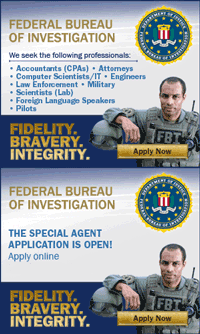
Attention, undergraduate and graduate students: Interested in being part of the war on terror? Breaking up an international crime ring? Identifying criminals who exploit young children on the Internet? Working side-by-side with top-notch forensic experts to solve a violent crime?

If you answered “yes” to any of the above questions, then the FBI Honors Internship Programmight be for you. This 10-week program offers students an insider’s view of FBI operations, from counterterrorism, cyber, counterintelligence, and fraud investigations…to vital support services like laboratory exams, fingerprint identification, and behavioral analysis. The program also provides an opportunity to explore a career with the FBI while working closely with our employees. We’re already accepting internship applications for the summer of 2009, and the deadline to apply is fast approaching—September 30, 2008.

What’s the application process?

  • Apply online.
  • Our field office closest to your school will then process your application, and the most competitive students will be interviewed. Names of top candidates will be sent on to our Headquarters in Washington, D.C.
  • Final decisions will be made in November; you’ll be notified soon afterwards if you made the cut.
  • We’ll conduct your background investigation.
  • Barring any problem with your investigation, you’ll be reporting for duty next summer at FBI Headquarters or another nearby facility.

To minimally qualify for the program, you must have at least a 3.0 GPA, be a U.S. citizen, pass a drug urinalysis screening and a polygraph, and have been absolutely drug-free for the past three years.

American Military University - An Intelligence Education Wherever You Are!

________________________________________


New Jersey City University - Professional Security Studies Department

________________________________________

The CICENTRE ... The Counterintelligence Centre for Advanced Counterintelligence, Counterterrorism & Security Education

________________________________________

Intelligence Courses at IWP

________________________________________

SCIP Institute

The SCIP Institute provides an integrated approach to fundamental CI principles and the latest thinking in specific CI disciplines. If you’re new to competitive intelligence, you’ll learn the ways in which CI can create a competitive advantage for your organization. If you’re an experienced CI practitioner, SCIP Institute provides a framework to expand your existing knowledge and provides the opportunity to showcase your skills and abilities to your employers. Get the details here.

________________________________________

Visit their website to locating those important Hiring Events for those who hold active security classifications.

Upcoming TechExpo Top Secret Hiring Events - Active Security Clearance Required

Full information available at www.TechExpoUSA.com

________________________________________

www.DefenseTalent.com Operates an online job board for the defense, aerospace and homeland security industries


Best Practice Forum: Leading the CI Function

This forum is designed specifically for the CI manager. It delivers innovative, practical solutions to your day-to-day and long term planning challenges that allows your department to stay ahead of the curve and grow its credibility in the organization. Join us to examine the dynamics of integrating CI into an organizational culture, and the tools and processes you can use to leverage your department and organizational talent. The forum environment allows you to explore best practices and key strategies through thought leadership and real world case examples that you can use immediately. The interactive facilitated discussion format provides time for valuable networking, open discussion with your peers and creating actionable, results oriented plans in a peer-to-peer environment. Get the details here.

________________________________________

Using Future Intelligence to Enhance Early Warning, Risk Management, and Innovative New Ideas

In this workshop, participants will learn how futures research, the analysis of long-term trends of society and technology out –five to 20 years, is a natural match for the competitive intelligence professional in his or her goal to help management understand the competition of tomorrow. They will learn case studies of how companies such as Dow Chemical and the Coca-Cola Company incorporate a regular flow of information about the future to understand hidden threats and opportunities. Once participants understand the value of foresight to the organization, they will learn the seven tools every CI practitioner can use to bring their decision makers a perspective on the future. Workshop participants will conduct a futures study - the future of beer - using research that simulates what an actual project would reveal. At the end of the day, those involved will understand how to study a variety of potential futures and present their strategic implications to senior management, adding vital information about the future to your competitive intelligence practice. Get the details here.

Careers in Intelligence

The following listings are jobs with federal agencies and corporations in or supporting the U.S. intelligence community.


Online University Available for Intelligence Career-Oriented Students

100% Online Bachelor and Master of Science (BS/MS) Degrees in Intelligence, Counterterrorism,
and Protection from Henley-Putnam University

Henley-Putnam University is a leading educational institution in the field of Strategic Security. Henley-Putnam's degrees in Intelligence, Protection, and Terrorism and Counterterrorism Studies prepare law enforcement, military, intelligence community, and private industry professionals with the network, skills, and insights to advance in their careers and protect the future. Henley-Putnam, an accredited member of DETC, offers Online BS/MS Degree Programs. For more information on Henley-Putnam University, call 888-852-8746 or visit us online at http://www.henley-putnam.edu/.

AFIO members and others are invited to consider new opportunities with MITRE, to see why they are one of Fortune Magazine's 100 Best Companies to Work For. If you possess a current Secret (or higher) clearance and a track record of success in any of the following areas:

  • Systems Engineering (Sensors, Complex Systems, Biometrics, Networks, Geospatial)
  • SIGINT Engineering
  • Software & Data Engineering
  • Enterprise Architecture
  • Information Security & Information Assurance
  • Cost and Acquisition Analysis
  • Contracts Administration
  • Communications Engineers (Missile Defense, SATCOM)
  • Electronic and Financial Crime Intelligence Analysis
  • Healthcare Informatics
  • Homeland Security/Critical Infrastructure Analysis
  • Modeling and Simulation Engineering
  • Operations Research Analysis
  • Organizational Change Management - Communications
  • Program Management/Earned Value Management
  • Software Packaging/Radia Engineering
  • Oracle Financials Development

Contact MITRE to explore new career options.  http://www.mitre.org


CAREERS IN INTELLIGENCE WITH DHS
Start you intel career, now. NINE positions at the Department of Homeland Security Headquarters are listed below. They look forward to receiving resumes from qualified candidates. 

JUST IN. Start 2006 with a smart career move to DHS. Many announcements for positions at the Department of Homeland Security-headquarters arrive each week. These positions are posted on www.usajobs.opm.gov. DHS looks forward to receiving resumes from qualified AFIO candidates. For vacancies with DHS components including FEMA, Coast Guard, etc., please check their postings on www.usajobs.opm.gov.

For vacancies with DHS components including FEMA, Coast Guard, etc., please check their postings on www.usajobs.opm.gov.


Sparta

a systems engineering and advanced technology company has openings in Administration, Engineering, Management, Systems Analysts, and Technical with positions in California, New Mexico, Arizona, Massachusetts, Virginia, Maryland, and Florida.


OTHER AGENCIES AND GROUPS PROVIDING CAREER OPPORTUNITIES

IntelligenceCareers.com
http://www.intelligencecareers.com/_homeroom/index.cfm 

Find more than 650+ jobs online at anytime on this splendid intelligence career & intel career transition site, filled with plum positions for or about: analysts, cybercrime, COMINT, COMSEC, direct support to intelligence efforts around the world, ELINT, engineering, IMINT & Imagery, INFOSEC, linguistics, mathematicians, policy development, technology, and just about any career requiring a security clearance and a whole lot that don't.

A sample of the kinds of organizations that you'll find offering opportunities: ACS Defense, Boeing & Boeing Satellite Systems, CACI, IntelData, Lockheed Martin, the NSA, SAIC, Sytex Inc., the U.S. State Department, and U.S. Investigations Services (USIS).


PERSONAL EXPERIENCES - QUESTIONS AND ANSWERS

A series of video Q&As about Joining and Training for the position of a CIA Clandestine Services Officer
by Lindsay Moran, author of "Blowing My Cover" via VideoJug

Lindsay Moran Videos on her personal experience with a career in CIA
   
Lindsay Moran


Joining The CIA
Questions covered:
1.How can I join the CIA?
2.What types of tests will I take before being accepted to the CIA?
3.What type of training should I have before I apply to the CIA?
4.How do I make myself stand out when applying to the CIA?
5.How old is too old to work at the CIA?
6.How do I know what positions are available at the CIA?
7.If I'm not a U.S. citizen, will I be able to work for the CIA?
8.How much money could I make working for the CIA?
9.Can I tell my friends and family I work for the CIA?


The Life Of A CIA Spy
Questions covered:
1.What is a 'CIA officer'?
2.What is a 'CIA agent'?
3.What type of training must a CIA Officer go through?
4.Does a CIA officer train a CIA agent?
5.What is the typical day for a CIA officer?
6.What are the responsibilities of a CIA officer?
7.What are the responsibilities of a CIA agent?
8.What types of danger may a CIA officer face?
9.What types of danger may a CIA agent face?
10.How does a CIA officer recruit an agent?
11.Will a CIA officer follow the laws of a foreign country when in that country?
12.What is 'diplomatic cover'?


Life As A CIA Spy: The Life Of A CIA Case Officer
Questions covered:
1.Does the CIA spy on people living in the US?
2.Does the Patriot Act allow the CIA to spy on US citizens?
3.How does a CIA spy live a double life in the U.S?
4.What types of spying would a CIA officer conduct in the US?
5.How often will a CIA spy travel out of the US?


Training For The CIA
: Recruiting CIA Agents
Questions covered:
1.What is 'Recruitment Training' for the CIA?
2.How much time is spent training to recruit agents for the CIA?
3.Why is recruiting agents so important to the CIA?
4.What types of trainees fail during the agent recruitment stage?
5.How has the agent recruitment training helped you in the field?
6.How is the agent recruitment training conducted?


Life As A CIA Spy: The Personal Life Of A CIA Case Officer
Questions covered:
1.How much time off does a CIA spy receive per year?
2.What does a CIA spy need to do when requesting time off?
3.How does a CIA spy in foreign territory make friends?


Training For The CIA: The Mind Of A CIA Spy
Questions covered:
1.What types of mental training exercises do CIA officers receive?
2.Why are the mental training exercises important to the CIA?
3.How are mental training exercises conducted?
4. What types of trainees fail during the mental training exercises at the CIA farm?
5.How do the mental training exercises help in the field?


Training For The CIA: The CIA Farm
Questions covered:
1.What is the CIA 'Farm'?
2.What type of training takes place at the CIA farm?
3.Where is the CIA farm?
4.How much time do CIA trainees spend on the farm before becoming a CIA officer?


Training For The CIA: CIA Physical Training
Questions covered:
1.What types of physical training do CIA officers receive?
2.Does the physical training help CIA officers in the field?
3.Do CIA officers continue to be physically fit after training?
4.How difficult is the physical training for the CIA?
5.What types of trainees fail during physical training at the CIA farm?
6.How does the physical training from the CIA help you in the field?


Training For The CIA: CIA Surveillance Detection
Questions covered:
1.What is 'Surveillance Detection Training' for the CIA?
2.How much time is spent on surveillance detection training?
3.How will surveillance detection training help you in the field?
4.Why is surveillance detection training important to the CIA?
5.What types of trainees fail during surveillance detection training?
6.How is surveillance detection training conducted?
7.Have you ever been detected by a surveillance shadow?


Developing A Cover As A CIA Spy
: Spying For The CIA
Questions covered:
1.What does spying for the CIA entail?
2.What countries do CIA officers spy on?
3.How does the CIA decide where to send officers to spy?
4.What does a CIA officer actually try to find out?
5.What type of equipment is given to CIA officers while spying?
6.What training is most valuable while spying as a CIA officer?
7.What types of danger do CIA officers face while spying?
8.What are the toughest things about spying for the CIA?
9.What laws do CIA spies commonly break?
10.How do CIA spies help America?
11.Does the CIA spy on Americans?
12.What would happen if a spy was caught in foreign territory?


Developing A Cover As A CIA Spy
Questions covered:
1.What is a 'Cover' for a CIA spy?
2.How is a cover established?
3.Does a cover change your whole identity?
4.What happens if you forget your cover?
5.Does your family know your cover name?
6.Why is a cover needed for the CIA?
7.How often is a cover used in the CIA?
8.What is an example of a typical cover?
9.Have you ever known anyone who's blown their cover?
10.Does your cover change for different missions?


Life As A CIA Spy: Living Abroad As A CIA Clandestine Services Officer
Questions covered:
1.How many CIA spies live abroad?
2.What type of allowance is given to CIA spies living abroad?
3.How does a CIA spy living abroad keep in touch with friends and family?
4.How is a CIA spy like James Bond?
5.What are the perks to being a CIA spy living abroad?
6.Who are the best types of CIA spies?
7.When are CIA spies sent to other countries?
8.How can a CIA spy living abroad avoid confrontation?
9.Why does the CIA have such a bad reputation with the rest of the world?
10.Does a CIA spy live like James Bond?
11.Do CIA spies date foreigners when living abroad?


Developing A Cover As A CIA Spy: Obtaining Foreign Government Secrets For The CIA
Questions covered:
1.How does a CIA officer obtain foreign government secrets?
2.What is a CIA agent?
3.Is recruiting CIA agents an effective way to obtain foreign government secrets?
4.What other ways are foreign government secrets obtained?
5.How much will a recruited CIA agent earn for giving the CIA foreign government secrets?
6.What do CIA officers look for when recruiting a CIA agent?


Life As A CIA Spy: Living In The US As A CIA Officer
Questions covered
1.Does the CIA spy on people living in the US?
2.Does the Patriot Act allow the CIA to spy on US citizens?
3.How does a CIA spy live a double life in the U.S?
4.What types of spying would a CIA officer conduct in the US?
5.How often will a CIA spy travel out of the US?


Joining And Quitting The CIA
: Quitting The CIA
Questions covered:
1.How does a CIA officer leave the CIA?
2.Why would a CIA officer leave the CIA?
3.What other opportunities does a CIA officer have after leaving the CIA?
4.What does the CIA do to make an officer stay?
5.Can the CIA prohibit an officer from leaving?
6.How often do CIA officers leave the CIA?
7.Will the CIA ever contact an officer after they quit the CIA?


CIA Rules & Regulations
Questions covered:
1.What types of rules does the CIA have for trainees?
2.What types of rules does the CIA have for employees?
3.How seriously are CIA rules enforced?
4.Are the rules of the CIA outdated?
5.What types of regulations restrict employees from having a personal life?
6.Do CIA employees follow the rules and regulations?


Today's CIA Missions

Questions covered:
1.What are the 'Family Jewels' files that were recently released by the CIA?
2.How has the War On Terror changed the CIA?
3.How involved is the President with the CIA?
4.What types of misinformation does the public receive from the CIA?
5.What are examples of current missions of the CIA?
6.What are some myths about the CIA?
7.Why does the CIA deny events, then admit to them decades later?
8.Is there an alliance between the CIA and FBI?


About Lindsay Moran

www.blowingmycover.com


Federal Agencies


Office of the Director of National Intelligence

Central Intelligence Agency

National Security Agency


Federal Bureau of Investigation

Defense Intelligence Agency

National Reconnaissance Office (Career openings via DOD)


Department of Energy


Department of State


Treasury Department, Office of Intelligence Support and U.S. Secret Service

Army Intelligence

Naval Intelligence

Air Force Intelligence, Surveillance, and Reconnaissance

Marine Corps Intelligence

National GeoSpatial-Intelligence Agency


Coast Guard


Department of Homeland Security

Home I About Us I Members I Chapters I Corporate I Publications I WorldWideWeb